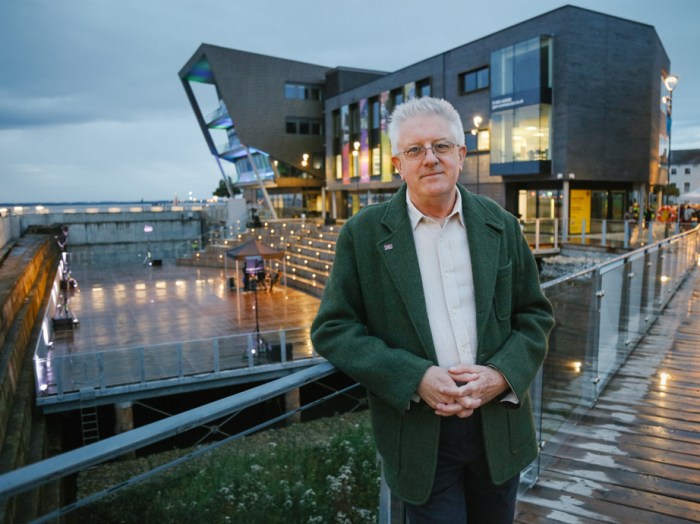
Moments in Time – Music for a celebration…
“I was commissioned by Lou and Richard Duffy-Howard to write a work for the Open Bridges event in 2017.
The only requirement was its duration of 20 minutes and 17 seconds, reflecting the date and timing of the first performance.
Its inception came whilst I was in Goodmanham – a small village near Market Weighton, listening to rooks in the trees – inspiration is complex and multi-layered and in many ways unexplainable … I knew then that the piece would begin and end with the sound of birds and take the listener on a journey from country in to city and beyond.
The river Hull and its bridges offered me a palette of sounds that the piece would use and to that purpose I was able, with help from Richard and Lou, to access all the bridges and record the sounds they made when opening and closing as well as the environmental sounds of traffic and water. We went from bridge to bridge on a very hot day, and recorded the material I would use. Other sounds came from the cafe in Debenhams, crowds beside Princes Quay, Humber Street, the sounds of horses’ hooves on a road at Lastingham, the sounds of car tyres running over the road surfaces of the bridges and the sounds of water and bells.”
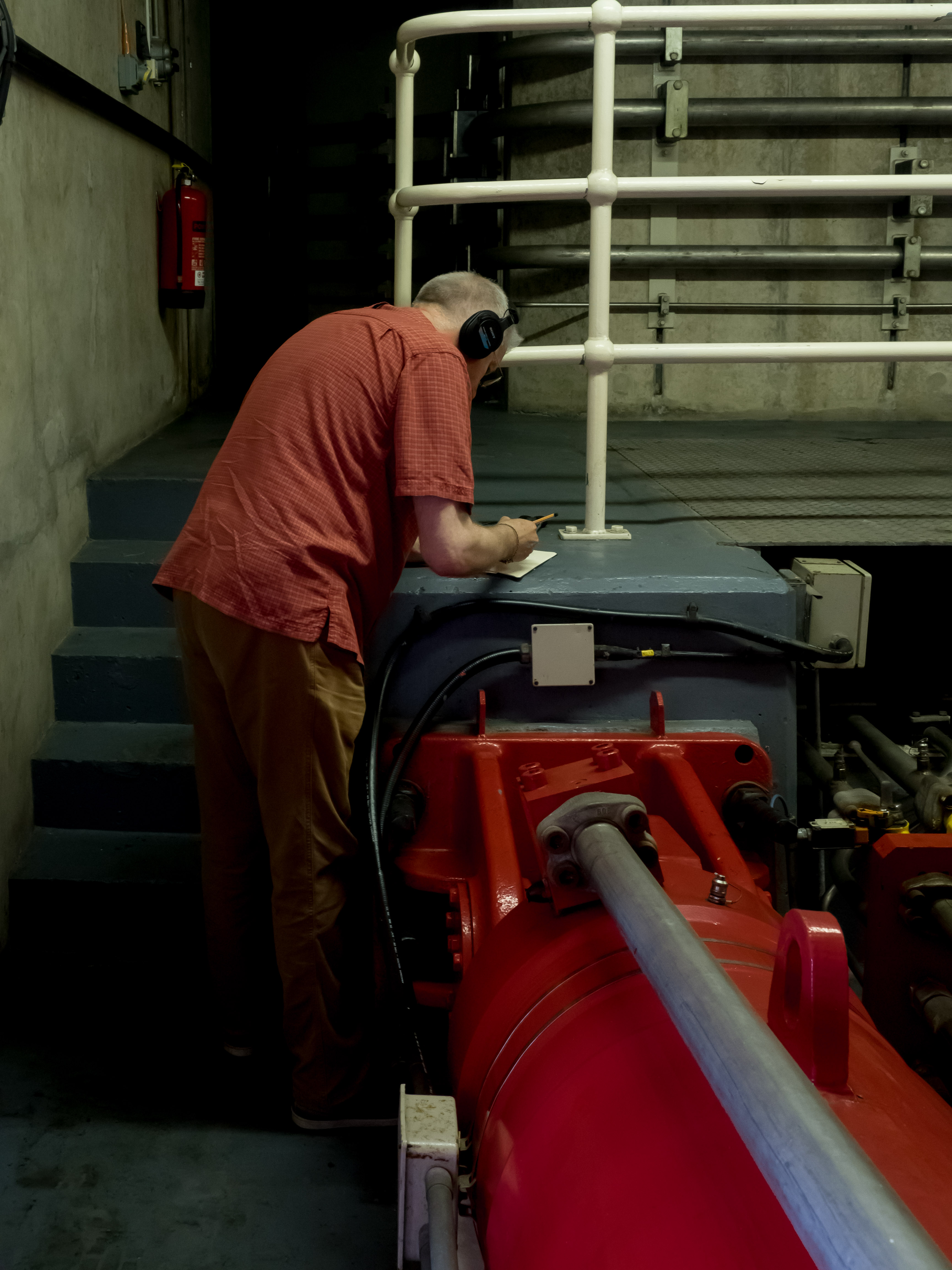

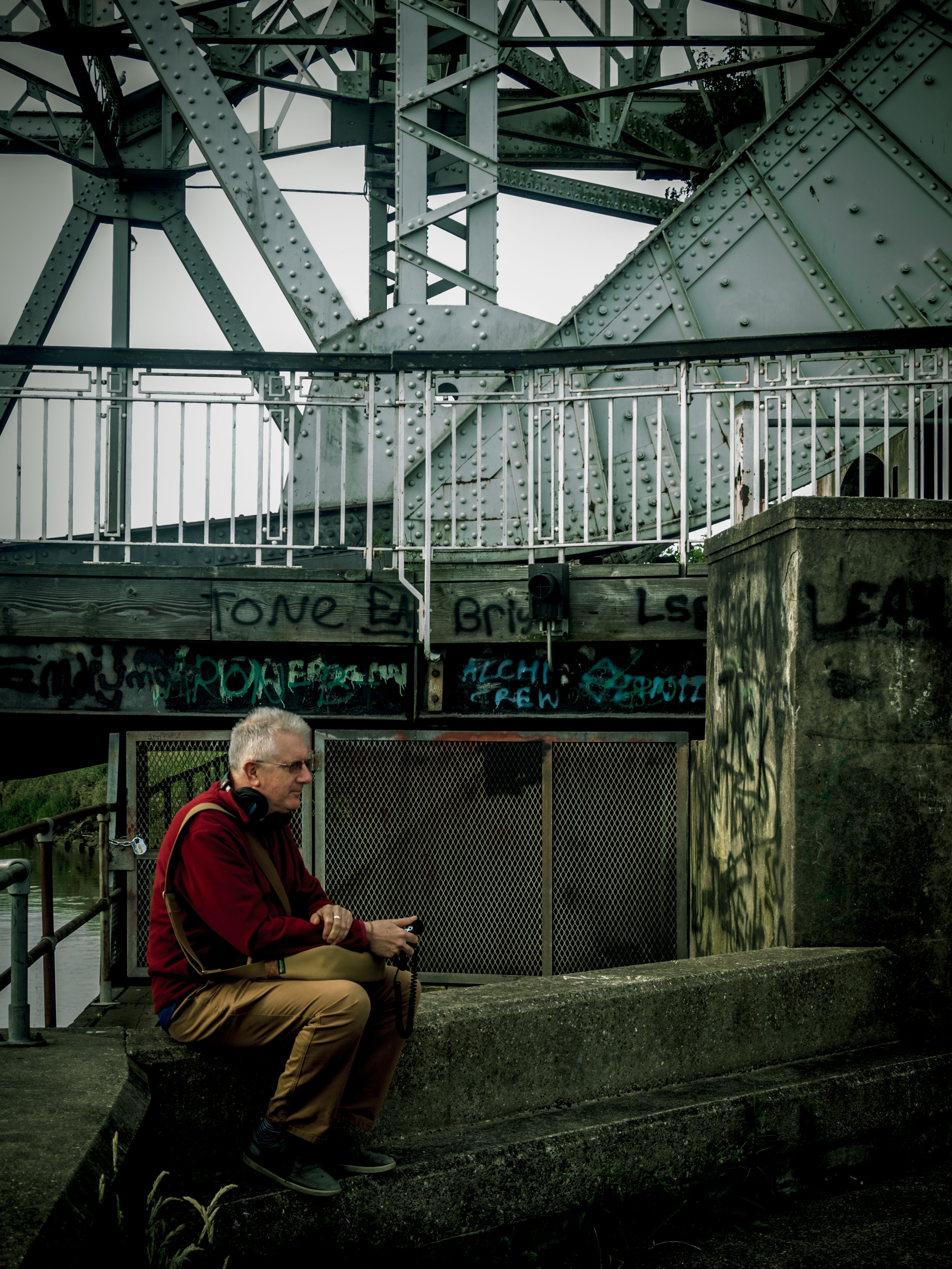
John recording in Stoneferry’s cylinder chamber, at Wilmington and Sutton Road
“The performance was to be at the Stage at The Dock at the mouth of the river Hull, where it joins the Humber Estuary. I wanted the work to surround the audience and used an octophonic sound system. The Stage at the Dock is acoustically complex as it has a variety of surfaces that reflect and absorb sound and with the help of the technicians from HPSS, including rehearsing with the Yamaha mixer I would use, we managed to balance the sound with careful customised placing of the loudspeakers.
When composing an acousmatic work, the sounds have their location and spatial movement embedded. The software used to locate and spatially modulate the sounds, from the ebb and flow of large scale water sounds to the clouds of small Tibetan bell sounds is created using Ina GRM Tools. The execution of this aspect of the sounds in the studio is a mixture of sophisticated fluid/gestural and extreme precision programming, controlled via MIDI.”


GRM Tools and preparing for Moments in Time at the Stage at the Dock for Open Bridges
“During the live performance the mixing desk is used to diffuse the sound, acoustically balancing the sound to accommodate the acoustic changes produced by the presence of the audience etc.
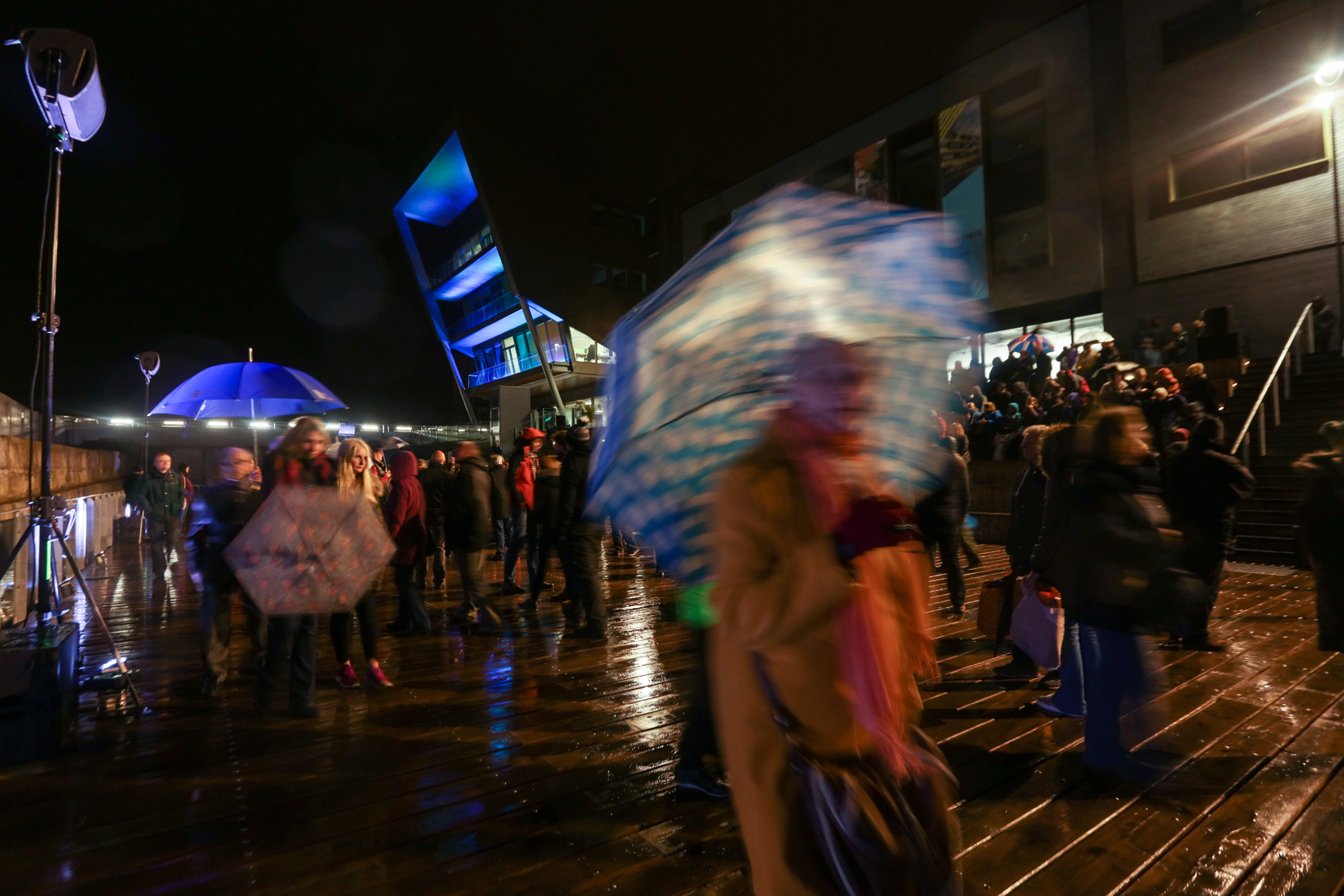
Open Bridges – Moments in Time by Graeme Oxby
The structure of the work was modelled on Mussorgsky’s Pictures at an Exhibition where scenes (and in this case series of sonic tableaux) are presented sequentially – taking the listener from the rural to urban landscape through a series of reflective moments…
The performance took place to a full house – everyone enjoying the experience.”
© John Stead 2025.
You can download a copy of the evenings programme here and read Johns programme notes for the concert below.
Programme Notes:
“…the advent of electricity in music is the most important musical event of the 20th Century” Olivier Messiaen
Moments in Time by John Stead (2017)
Duration: 20:17
A short time after I had been given this commission I was walking in the Wolds, listening to rooks calling and decided to record them. At that point I realised these sounds would begin this work – everything else followed…
Whilst working on the piece I was informed that Jean-Claude Risset had passed away. I had recently been in touch and he was hoping to visit here, so Moments in Time is also a tombeau for Jean-Claude Risset. Throughout the piece there are allusions to some of his work as well as the use of his Shepherd Tone process. The dualities clearly present in the idea of freedom are found in the structures of the work – absence/presence, high/low, fast/slow, old/new etc.… The form and dynamic of the piece are influenced by the nature of the recorded sound material with an aesthetic which refers to the surreal world of Jean Guillou’s ‘Alice du pays de l’orgue’ and the magnified Bardo visions of Tibetan Buddhism.
The work begins with the sounds of rooks interrupted by a car which heralds a collage of moments of a journey via the bridges to a period of calm. Bells and their extended harmonic resonances signify the second part where the sounds of the first part are further transformed spectrally, extended into a gradually rising structure which eventually returns us to the rooks …a moment later…
Elementa by Jean-Claude Risset (1998)
Duration: 22:04
This work refers to the 4 elements defined by Empedocles: earth, water, air and fire.
These correspond to physical states of matter; solid, liquid, gaseous and ionized and are vivid metaphors for electro-acoustic sounds – their plasticity, their changes in form and matter.
Elementa was commissioned to celebrate the 50th anniversary of musique concrète by the Groupe de Recherché Musicale (GRM, Paris) and uses the GRM tools software.
The four sections are: Aqua, Focus, Aer and Terra.
Interval: 15 mins.
Cycle du Son by Francis Dhomont (1998)
This cycle celebrates sound – a major discovery of the 20th Century – and musique concrète. It is a 50th anniversary homage to Pierre Schaeffer who created musique concrète.
Cycle du Son falls into 4 parts:
Objects Retrouvés (1996) in memoriam Pierre Schaeffer.
Duration: 5:20
We hear some of Schaeffer’s objets sonore (from the first part of his Etude aux objets) developed and ornamented, used in a rather formal contrapuntal way as to honour the memory of Pierre Schaeffer.
AvatArsSon (1998) …to the “inventors of the ‘treasure'”.
Duration: 18:11
This section plays homage to many of the composers who have discovered and developed particular sound objects in their works – Pierre Henry, Francois Bayle, Luc Ferrari, Karlheinz Stockhausen, Iannis Xenakis, Jean-Claude Risset, Edgar Varese, Michel Chion, Guy Reibel and Denis Dufour to name a few. Here we hear small fragments of their works transforming and developing…
Novars (1989) …to musique concrète and Pierre Schaeffer, its “unfortunate inventor”.
Duration: 19:06
This is the centrepiece of the work and was the first part to be composed. Fragments of The Messe Nostre Dame of Guillame de Machaut together with some elements of the objet sonore combine with sounds reminiscent of Pierre Henry’s work and develop into a multiplicity of variations.
Phonurgie (1998) …to Ines Wickman and her found objects.
Duration: 12:43
Phonurgie – making, working and creating sound, brings this homage to musique concrète and the objets trouvés heard throughout the work. In this last section, as Dhomont states “while the sound colour may no longer be the same, morphological thought and writing remain, in all of their many forms, true to the spirit of the first concerts de bruit” (noise concerts).
J.S.2017

John Stead is a founder member of the Electro-Acoustic Ensemble;
“a group who bring their disciplines and expertise to the perfomanceof, exploration into and creation of music with specific reference to son et lumieres with associated photography, film and video, sound installations, music, traditional and new digital media art forms. Their repertoire includes works by Olivier Messiaen, Pierre Boulez, Karlheinz Stockhausen, Peter Maxwell Davies, Jean-Claude Risset, Francis Dhomont and Karen Tanaka amongst others”.
Find out more about the EAE and their upcoming concerts here: https://eae.org/
Rich and Lou Duffy-Howard
If you’ve enjoyed the post, we’d be delighted if you’d subscribe to our blog. It’s free and you can do so by entering your email below: