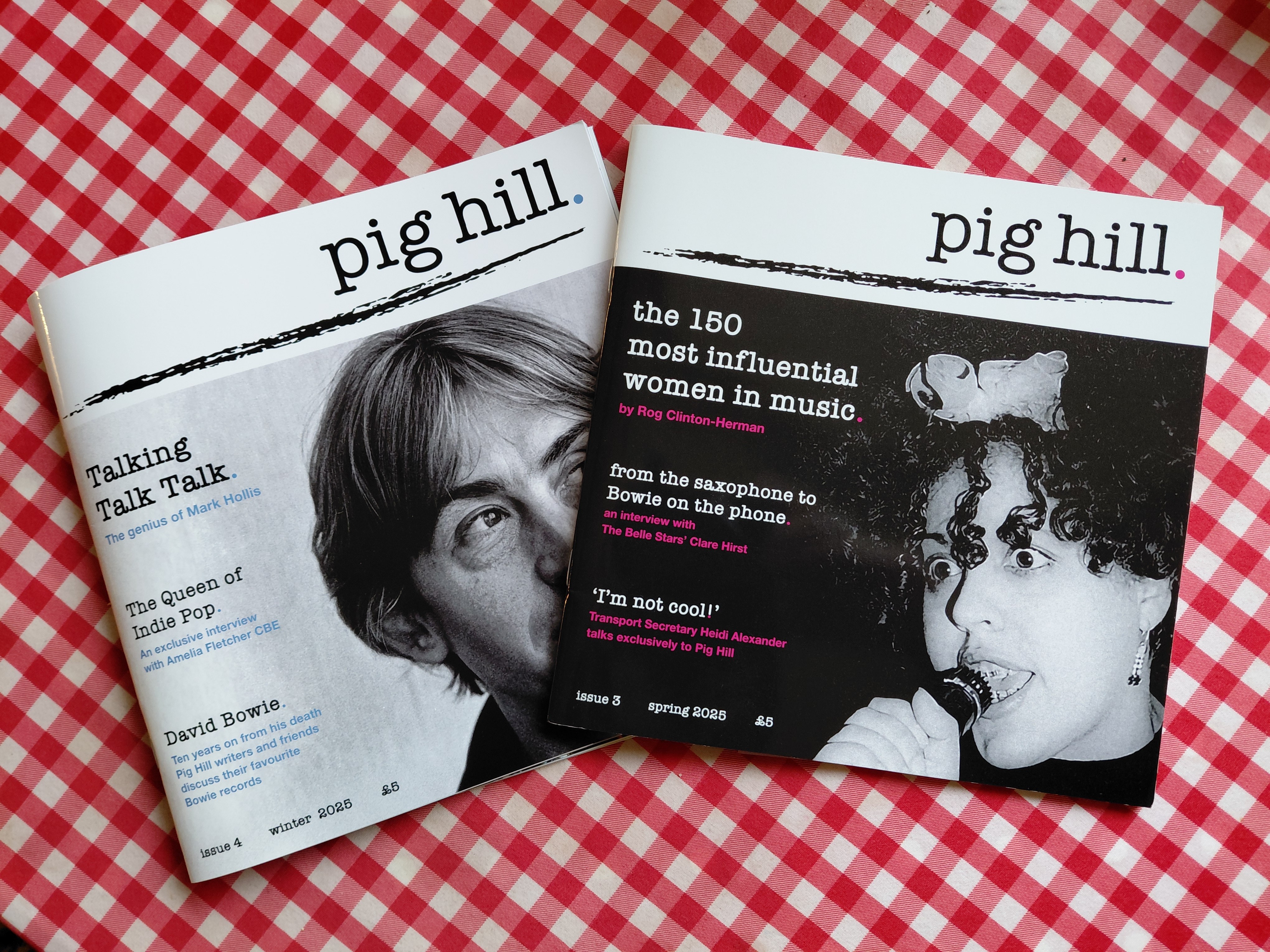
Thanks to Pig Hill magazine for inviting us to write a feature for last year’s winter issue. Pig Hill is a super high quality printed magazine covering politics, poetry, art, music and opinion. It was interesting to write about Open Bridges for a national magazine. We had to explain elements of it which are obvious to us in Hull, for a wider audience (eg, the difference between the River Hull and the Humber).
Open Bridges in PIG HILL MAGAZINE
“Apart from music, my husband Rich and I have another project on the go – Open Bridges – an off the wall idea, which has turned into a passion. Of all the activities and events I have been involved in over many years, this was the most challenging by far, and has evolved into the most rewarding.
Our idea for Open Bridges was to make history during Hull’s City of Culture year 2017, by arranging for all the bridges over the River Hull to open at the same time on the autumn equinox, to split the city in two, to deny freedom of movement, to explore, experience and maybe understand what that removal of freedom may feel like. We arranged for a flotilla of historic vessels to sail down the river to be met in the Humber by three 21st century tugs to the sound of the especially commissioned John Stead’s musique concrète work ‘Moments in Time’ which John diffused in octophonic sound on the night in a converted dry dock at the mouth of the river, as the ships sailed past. The journey was filmed by 16 filmmakers and a drone, and can be seen with the musique concrète soundtrack on the Open Bridges website.
But first, back to the beginning. As our discussions developed it became clear that the whole thing would be a logistical first. We realised that Hull is the only city in the world with so many bridges – 13 – that all open over the navigable stretch of river, as it flows north to south and out into the Humber estuary, and as we started planning, the magnitude of making it happen became apparent. The whole thing was a massive challenge, managing health and safety, traffic management, emergency services, counter terrorism, the tide, the wind, the weather, groups of people who rarely mixed together, and not least managing the public discussion about freedom that we created. So many different cogs literally had to fall into place, but we worked with a great team of council staff, river workers, bridge operatives and vessel owners – and together we did it!
Since then the project has grown and now has a life of it’s own, with stories, photographs, art, films, exhibitions and a book which continue to preserve and tell the story of life on and around the River Hull.
Hull is situated on the north bank of the Humber estuary, and is known for the Humber Bridge. But Open Bridges is not about that bridge or The Humber. It’s about a different river, the River Hull which flows down from the Yorkshire Wolds to the north of the city, cutting the city in half, and out into the Humber. East and west Hull have distinct personalities and people with historically, the fishing communities living west of the river and people working on the commercial docks in the east. People would sometimes rarely or even never cross from one side to the other. We famously have rugby league teams on each side, east and west, and consequently plenty of rivalries.
As the primary way of moving goods across the country, barges on the inland waterways were of paramount importance and greatly influenced people’s work and leisure time over many years. But with the decline of the inland waterway traffic, the heritage of the people living and working on the river is largely forgotten. In it’s heyday working on the barges was a job for life and an essential part of transportation in the UK but in the 80’s when the river work was overtaken by road traffic the barges literally disintegrated or were turned into house boats. Over recent years, the story of the river people has been under represented in the history of the city of Hull which is mostly known for deep sea fishing – trawling and previously whaling.
Rich and I had the idea for Open Bridges in 2015, while walking along the riverside, and talking about Hull’s upcoming year as City of Culture 2017, and how the River Hull has historically been the lifeblood of the city, the reason Hull has grown here. We discussed how we could raise the profile of the River Hull and the importance of the bridges linking east and west. We thought that the River Hull and its bridges should be central to any celebration of the city. As these new ideas took shape they linked with projects we had undertaken in the past. Rich’s work had taken him behind the scenes of the bridges over the river Hull, where he had seen their fascinating lifting mechanisms. I had been involved in the management of Hull’s activities to mark the bicentenary of the abolition of the slave trade ‘Wilberforce 2007’ from which the concept of Hull as a city with links to freedom emerged. At the time we seemed to be surrounded by news of the loss of freedoms on a worldwide scale. Rich and I talked about our understanding of this, and how it’s difficult to truly understand what freedom means until it has been taken away. From these two things came the idea for Open Bridges. What if all the bridges were to close to traffic at the same time, splitting the city in two so that no one could pass from east to west or vice versa? This would take away the freedom of movement from one place to another. We wondered what feelings would emerge? What difficulties would it bring? Splitting the city in two would be more of a symbolic happening than a one off event, so we talked about how we could best capture it, how to engage people using photography, conversations, music and art.
On Open Bridges night, after months of meticulous planning, everybody worked together to overcome the odds and make it happen. Rich and I were delighted that it went according to plan. Everybody had a different adventure, a different story to tell, depending on their role – for example, working on the bridges, on board the seven vessels, or part of the music concrète performance which we had commissioned especially for the event. Numerous groups of people were involved including the council, museums, emergency services and bridge operators. Vessels from four different centuries and their crews took part: HMS Pickle, MV Syntan, Humber Keel Comrade plus Humber Rescue and 21st century super tugs from SMS Towage and Svitzer Maersk. We commissioned Humber Film Creative Community – comprising 16 film makers – to make a 20 minute art documentary of the Open Bridges journey, and composer John Stead to create a 20 minute musique concrète work which was diffused in octophonic sound on the night.
John Stead’s composition, ‘Moments in Time’ uses recordings of river sounds, and the bridge mechanisms as they opened. These were integrated and manipulated to create a soundscape of the movements of the bridges, and the journey along the river Hull, from the source as it bubbles up in the Yorkshire Wolds down to the urban industrial city, and out into the Humber Estuary. Sixteen film makers filmed the journey on the night from each bridge, by drone, and from the barge, MV Syntan, as she sailed down the river. The film captures the changes from rural to urban, daylight to darkness.
Leading up to the event we held workshops in schools, libraries, the prison, and in a hospice. We talked about freedom and lack of freedom which then became the starting point for creative writing and art work. It was fascinating to discover how different groups of people were interested in a view of the river other than their own, and how perspectives vary according to where you are. Bridge operators wanted to ask vessel skippers what it was like to sail under the bridges, and vessel crews wanted to find out about the bridge mechanisms from the people who operated and maintained them.
In January of the next year, the Open Bridges exhibition inside Scale Lane Bridge drew 2000 visitors, many of whom told fascinating stories and recounted memories of their lives working on and around the river. The river people we met lamented the fact that whilst Hull is well known for its history of fishing, trawlers and whaling, the heritage of life on the river Hull itself is relatively unknown. Yet it is a rich history of lives spent working on barges, transporting cargo along hundreds of miles of inland waterways.
This led to the second part of the Open Bridges adventure, A River Full of Stories. This is an oral history project, in which Rich and I gather stories and memories of life on and around the river Hull. We have produced a series of films and a book overflowing with stories from river men and women whose lives intertwined with the river as it was in its heyday.
The Open Bridges exhibition inspired many discussions about the first stretch of the river before it enters the industrial and built up city, and the life of the river before it became an industrial waterway transporting cargo to and from the city. We heard about places to explore the springs and streams – one couple spoke of a spring rising in their own back garden.
We started to research A River Full of Stories on the first day of the heatwave in 2018. We set out to explore the sources of the river Hull, starting in the Yorkshire Wolds and making a dozen stops along the way. We found that the river tells a very beautiful, ancient and fascinating tale. During the lockdown I recorded a music and spoken word composition, illustrated with Rich’s photographs telling the story of our expedition.
Rich and I both love books so, in addition to the website, we produced a first edition Open Bridges book, A River Full of Stories. A copy was given to all libraries in Hull and the East Riding, and is available to all libraries in the UK. The pandemic delayed our plans to produce copies for a second edition, on sale more widely, but we’re planning to pick this up again in the future.
Open Bridges has all sorts of spin off activities and exhibitions. Just as the exhibition in Scale Lane Bridge was drawing to a close a new street piece by Banksy titled ‘Draw the Raised Bridge!’ appeared overnight on Scott Street Bridge. International urban art website GraffitiStreet.com published a feature referencing the link between the Open Bridges project and the Banksy artwork.
We have recently extended the project to include exhibitions, ‘Engines and Insects’, ‘What Makes The Humber’, ‘Goole by Barge’ and for the national Heritage Open Day festival in 2025 we go back full circle to the bridges to explore ‘Hull’s River Bridges’.” Lou Duffy-Howard 2025
Open Bridges is an independent not for profit project conceived and organised by Rich and Lou Duffy-Howard and delivered by an all-local team.
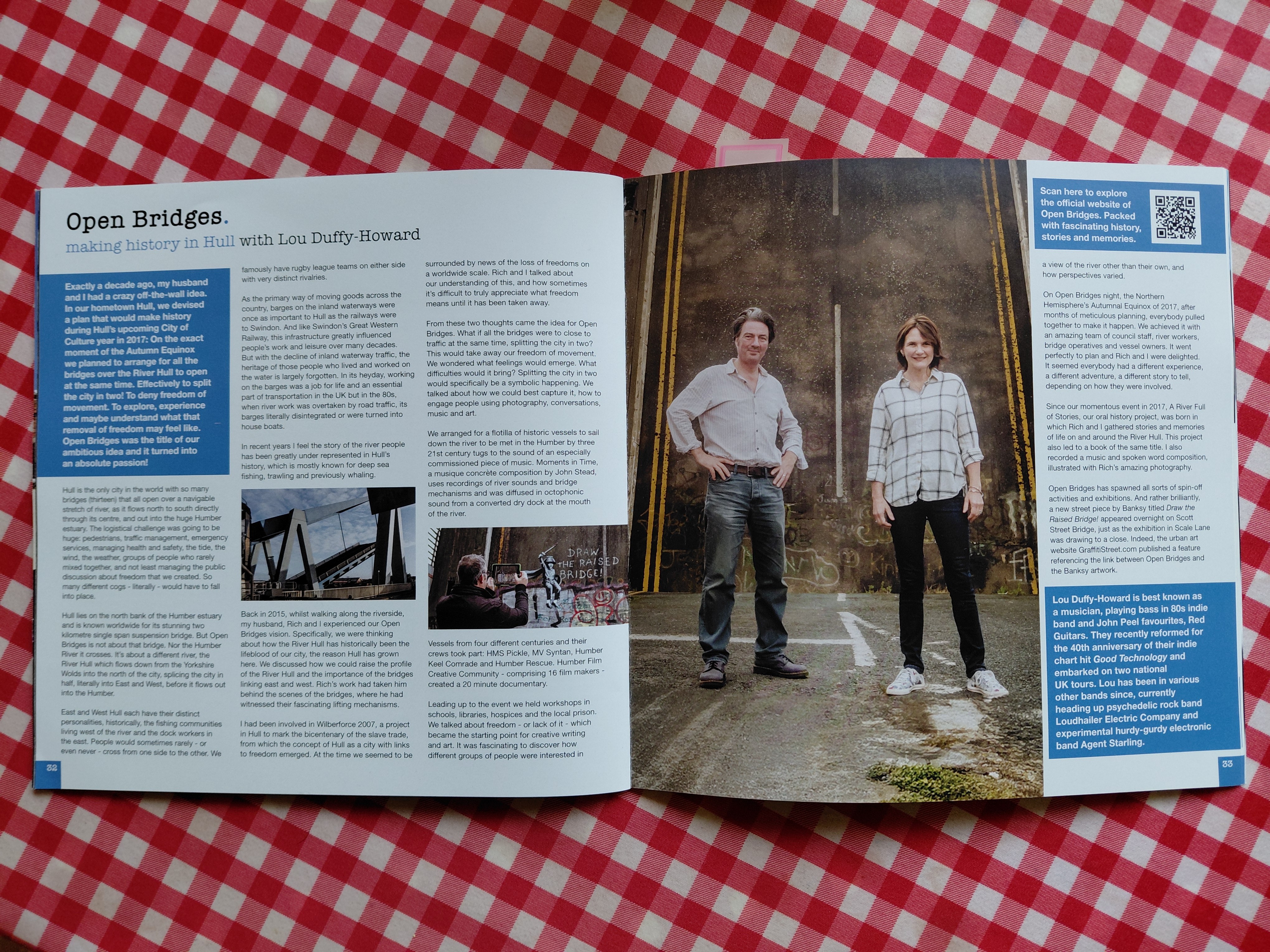
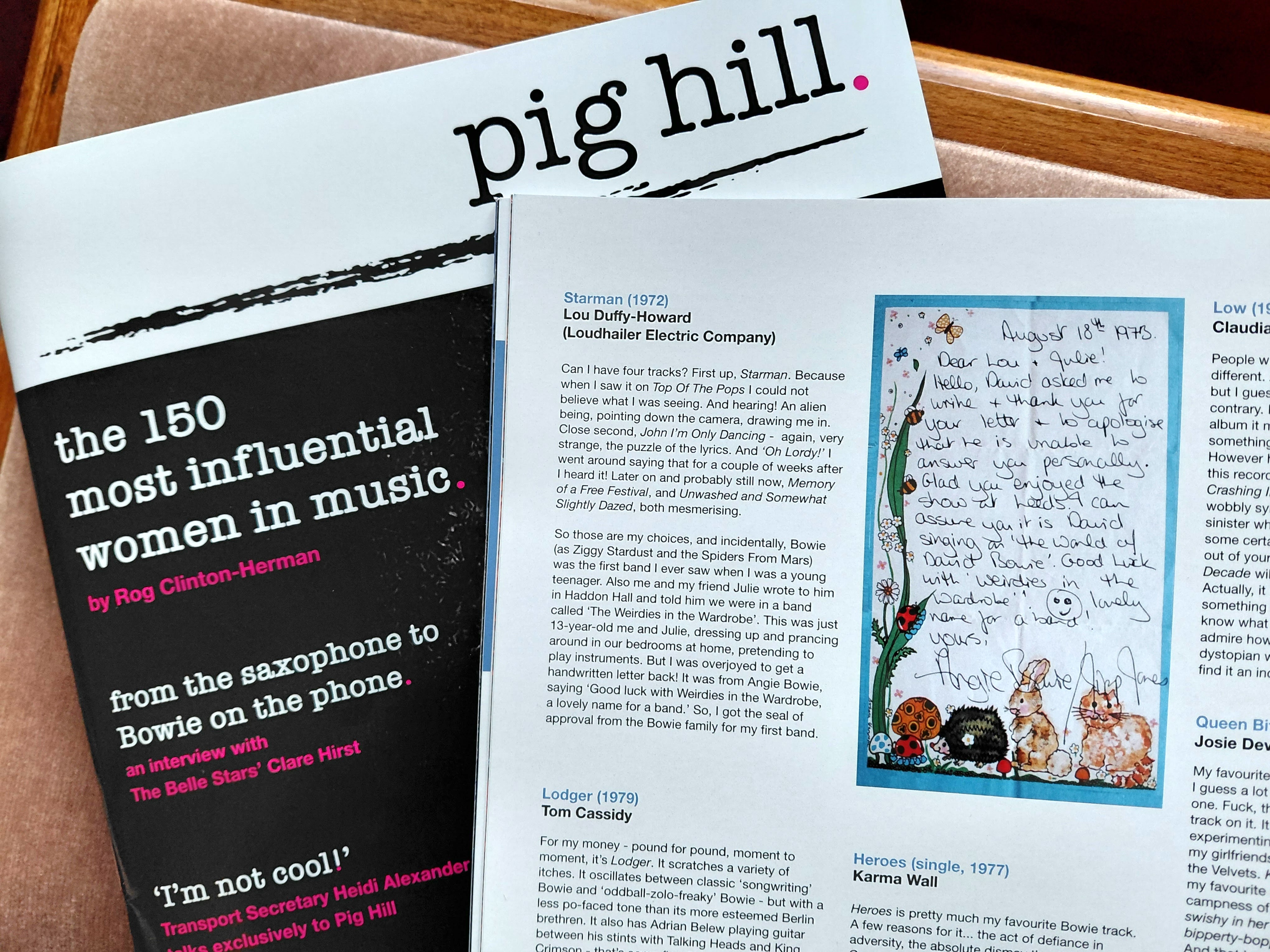
Lou is best known as a musician, originally for playing bass in Red Guitars. The band released a series of top Indie hits and went separate ways in 1985. They recently reformed for the 40th anniversary red vinyl re-release of first single Good Technology, and two UK tours. Throughout the intervening years, Lou continued to play music, currently heading up psychedelic rock band Loudhailer Electric Co. and as one half of experimental electronica and hurdy-gurdy band Agent Starling. Still living in the East Riding of Yorkshire, Lou has other strings to her bow and here talks about the independent not for profit heritage and culture project she runs with her husband Richard, ‘Open Bridges’.
Pig Hill
Pig Hill is a not-for-profit publication run as a labour of love by Swindon-based folk who love their town and its history. The first 50 copies of the hand-numbered limited edition magazine are given away free to pubs and coffee shops in Swindon.
Pig Hill editor Rog Clinton-Herman is a Swindonian. He left Swindon to study Politics at university. Over three decades later, via Manchester, Montreux and London, he has now returned to the Swindon area.
Pig Hill is a not for profit independent publication. You can get future editions here.