Steven Oakden contacted us last year with his own personal story about the river. His story evocatively captures the last movements of the motor barge Swinderby in 2022. This is the second of four parts. All text and photographs copyright Steven Oakden.
About Swinderby
Built in 1974 by the New Holland Ship Yard for the gravel trade from the River Trent to Hull. Length 141 feet (43m) beam 28ft with a draft of 8ft 6 forward and 8’9” aft. Powered by a 450HP Kelvin 8-cylinder engine and fitted with a fish tail rudder to aid manoeuvrability. Original built as a ‘graveller’ or dry cargo barge. The Swinderby, and sister Collingham, were the largest inland waterway barges operating in the region. When the job of skipper was advertised several of the applicants withdrew because of the size of Swinderby, saying that it was too big for the river. Owned and operated by Mainmast Limited, the skipper (captain) is Tony Carty.
October 18, 2022
My first trip in September to see Swinderby moving was a damp squib as the engine wouldn’t start on account of the batteries being flat. It was 18th October when tide and my commitments allowed another attempt to catch a sailing. The day was lovely, sunny and warm so leaving home without needing a jacket I went by train to Hull and after spending the morning exploring the marina I went to see Pete Bayley who informed me that Swinderby would be leaving Cargills at noon, about 30 minutes before high tide. I got to Wilmington Bridge for 11.35 and soon two other photographers arrived, one of whom had come over from Grimsby. Eventually at 12.10 the bow of the Swinderby appeared under the railway bridge on Bankside, it was my first sighting of the barge.
Well loaded, right down in the water, it was broad or ‘beamy’ in nautical terms. I could see that the laid-up Rix Eagle was in the way because as Swinderby passed it moved away from the wharf. Rix Eagle’s mooring lines, taught at low water were slack at high water, and so Swinderby had to move away from it but not so far that it went off the channel and towards the mud bank on the east side of the river. As Swinderby approached I could see that it was very battered and in need of a repaint.
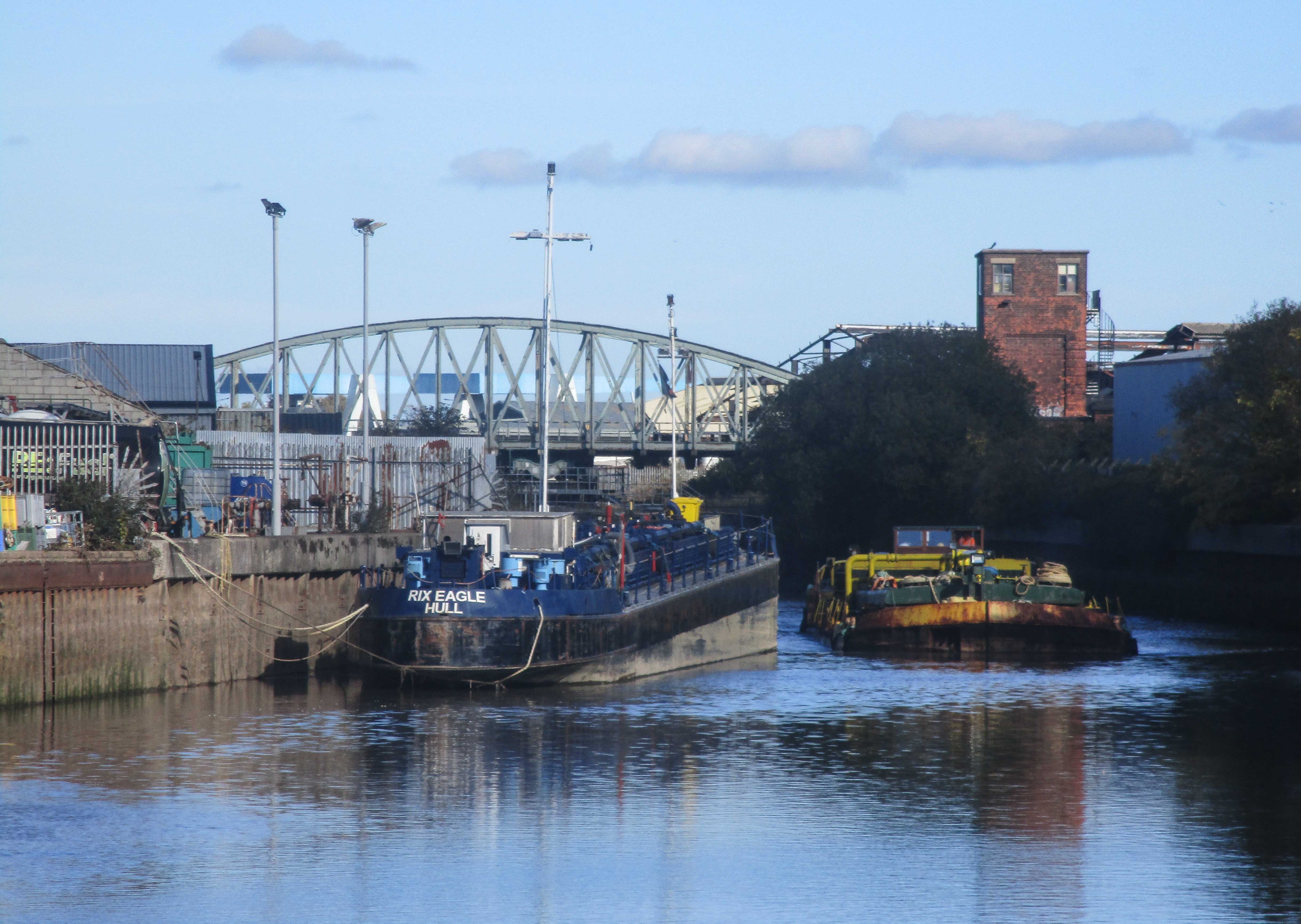


Rust and dents covered a large portion of its hull, the upper works and pipe runs on the deck were in better order. For a barge it was quite a brute. I watched and photographed it passing and going by Wilmington Bridge.


I set off running to get to the car park of a business further down river where I had already lined up that it would be a good place to photograph the barge on the move, with the railway bridge as a background. I manged to do this as Swinderby was moving very slowly.

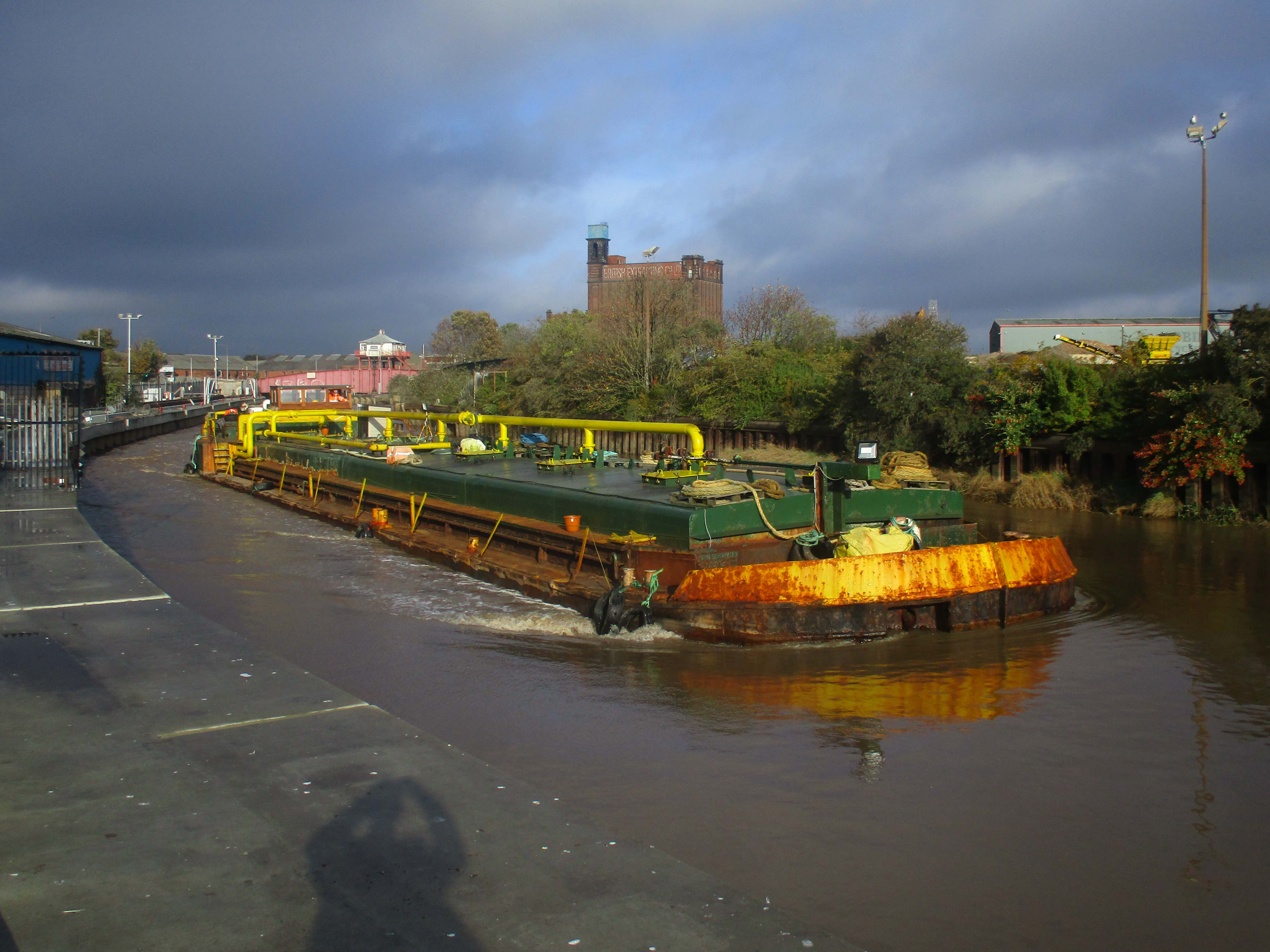
Having seen the state of the river at low tide I realised that if the barge stuck on a mud bank there was no help to be had, no wonder the journey was being done slowly. Going at speed would mean that if you ran onto a mud bank you would be more likely to get stuck whereas with a gentle grounding you might just get free if you went hard astern. In the days when the river was busy a nearby tug or another barge could be hailed to help, now there was no one. When the river was busy the mud banks would be flattened at low tide because the barges sat on the mud against the wharves. Now the channel was narrower, and a skipper had to know where the channel was, you couldn’t rely on it being in the middle of the river, it would be that the deepest water was on the outside of the curve on sharp bends such as the approach to Wilmington bridge and at Eagles Bight.
I now ran on, going down Cumberland Street as I wanted to get to High Flags to catch the Swinderby again. I had already checked that it was alright for me to go to the yard between the old mills. Palisade fencing didn’t help photography but making certain my camera was aimed between the mesh I was able to photograph Swinderby as it came round the bend from Sculcoates Bridge and past Dean’s Marine. I was surprised at how long I had to wait for it to appear.
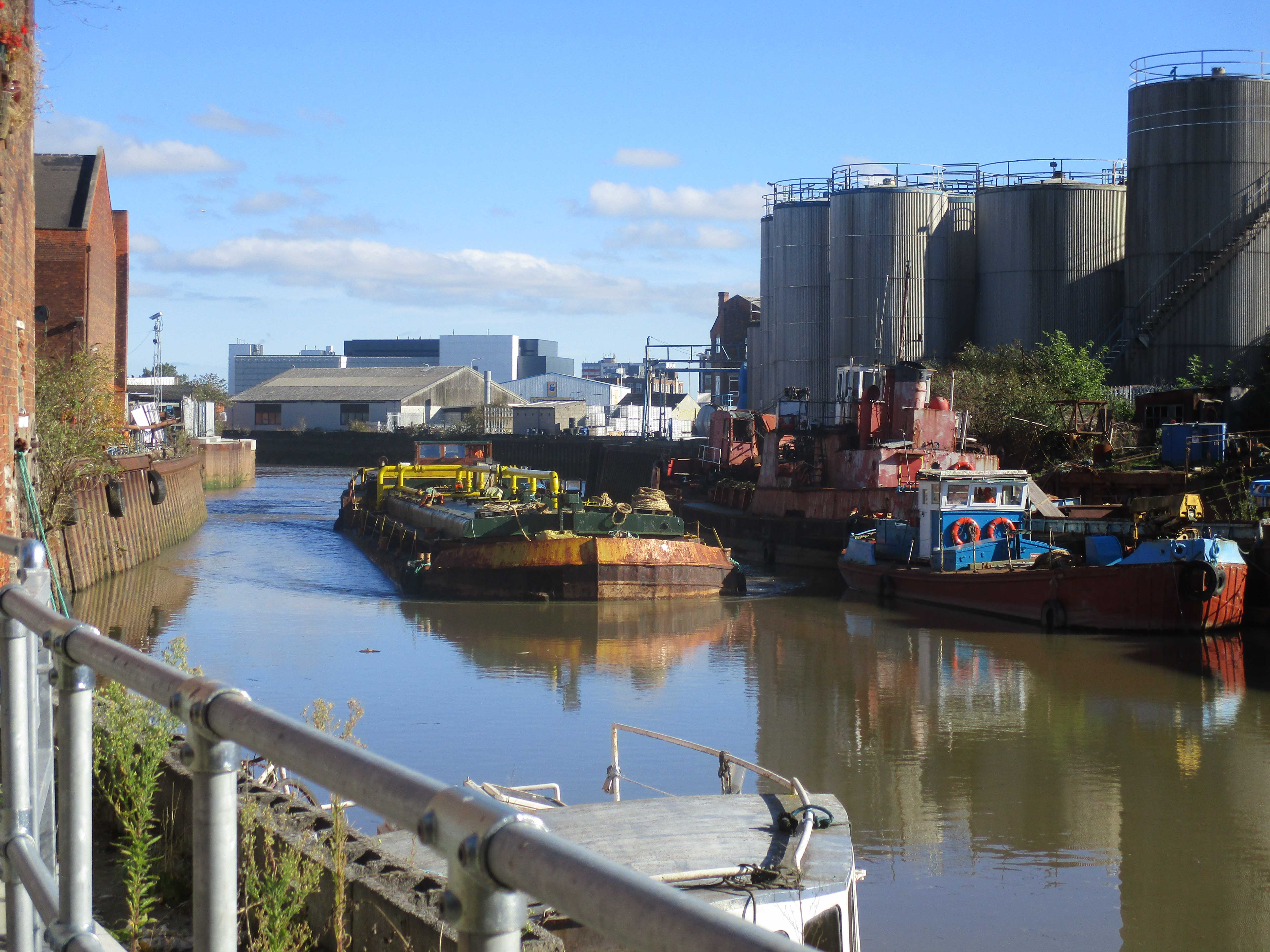
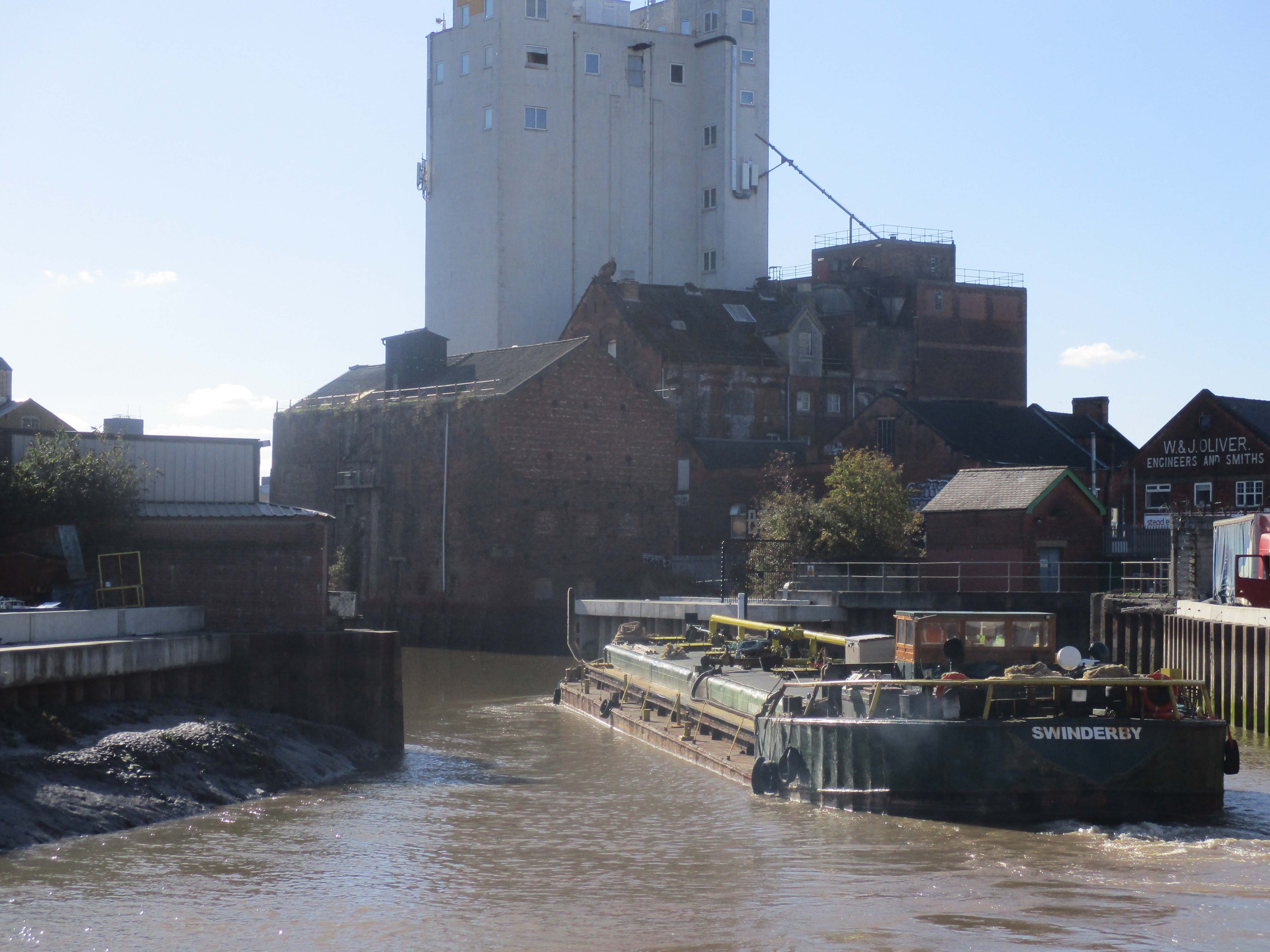
Turning round to face downriver more photographs were obtained as Swinderby approached Scott Street. Turning and running again I obtained more photographs opposite Chambers and Fargus before running down Wincolmlee. Photography here wasn’t good so I carried on past North Bridge and down to Blaydes House car park where I was able to photograph the Swinderby as it went past and under the raised Drypool Bridge. I could see Pete Bayley standing on the east side of the bridge watching proceedings.

Having secured photographs at five locations on a sunny clear day I was very pleased. At last, I had managed to see a commercial barge moving on the river. I went to thank Pete for his help, he received a call from Tony Carty, Swinderby’s skipper also thanking him for his help and letting him know that he was now clear of the river entrance and in the Humber. After asking Pete some questions I retired to the Trinity Market food court, feeling quite pleased with how things had gone, but keen to return again.
October 31, 2022
A second foray to see the Swinderby. With the short autumn days opportunities to catch the Swinderby in daylight, with matching tide times was proving difficult.
Pete Bayley was in his office at Drypool and said that the crew had already moved Paragon and would be setting about leaving with Swinderby. I walked quickly up Wincolmlee and sensed something was going on when I could see a bridge man in hi vis jacket up by Wilmington bridge waving his arms by the road junction. Sure enough Swinderby was already past the bridge which had been put back to its closed position already and it was moving by Rix’s depot. I dashed into the car park I had used on 18th October and in nice sun got the first handful of shots on camera, noting that the barge was going a bit faster than my last visit.

I then went down Cumberland Street to get to Eagles Bight. I did think about going to Sculcoates Bridge but the environs there are mostly modern processing works and I didn’t think that they would be too photogenic. I went straight to Scott Street as the last time I had only got going away photos and I wanted photos showing all the old wooden protection piers and the remains of the bridge. It wasn’t long before Swinderby came into view, but the sun had gone. I managed to get approaching and going away photos.

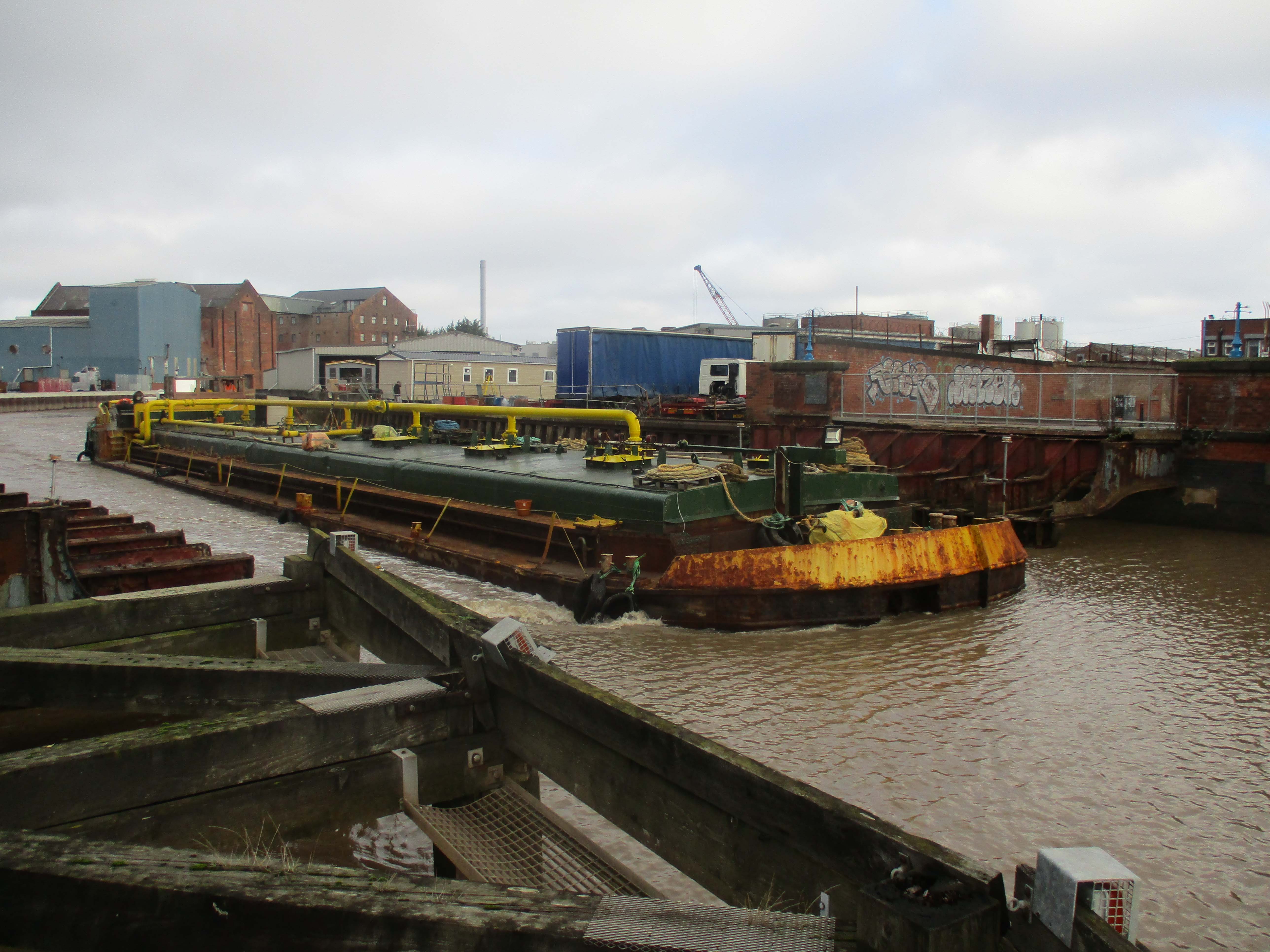
Once past North Bridge, Swinderby was slowed up and then stemmed the tide as it waited for Drypool Bridge to open, I managed more photos either side of Drypool Bridge before seeing it move off away down the Old Harbour.


Phew! It was all over very quickly and in a rush, but well worth doing and I had managed photos in four locations.
I then went to chat with Pete and I was able to see some of the entries in the Harbourmaster log of river traffic. I was intrigued to see that in August there had been a visit to Forge Wharf by Paragon carrying 150 tons of vegetable oils to IBLs storage depot. I didn’t know this still happened. Pete also told me that if there were problems getting through one of the bridges then the barge might moor at IBL at Forge Wharf in Eagles Bight or down at Lime Street Wharf.
Peter has yearly logs going back to 1991. I felt that these needed to be saved and digitised. Pete Bayley suggested that as Rich Duffy-Howard was working for the City of Hull Council he would be able to do far more to save these records than I would and that I should speak to him, a good idea, and something I did that evening.
All text and photographs copyright Steven Oakden.