The caption to the photograph above by Bernard Sharp reads: Humber Estuary, 1985. Visible at low tide at Marfleet Growths, the wreck of the concrete-hulled ‘Crete Street’ was built circa 1915. In the background is the Salt End jetty.
We forwarded the image and caption to Richard Lewis at www.thecretefleet.com who sent us the following fascinating article for publication:
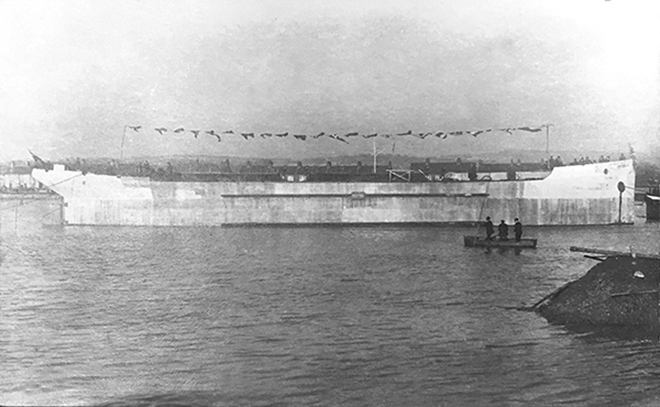
Cretestreet was one of twelve concrete vessels, six tugs and six barges, built at Shoreham-by-Sea.
She was launched on 11th October 1919 along with ‘Creteshore’ and ‘Cretesurf’, ‘Cretestreet’ was first registered on 13th December 1919 for ‘The Shipping Controller’.
| Name | Type | Reg. No. | Order No. | Launched | Completed | NRT |
| ‘Cretestreet’ | Barge | 143955 | PD133 | Oct 1919 | Dec 1919 | 598 |
Her first reported voyage was on 28th December 1919 when the Hull Daily Mail reported her departing from Hull to Antwerp with a cargo of pitch, and then her returning, light, at Albert Dock on 19th January 1920. On 23rd January 1920, she left Hull for Antwerp, again with a cargo of pitch, towed by ‘Creterope’ which was described by the Hull Daily Mail as a ‘Government Tug’.
After an encouraging start, ‘Cretestreet’ proved to be another early casualty, inexplicably sinking in King George Dock, Hull, on 10th February 1920 whilst being loaded with coal.
According to the Liverpool Journal of Commerce:
‘The Salvage Association have received the following advice from their surveyors, dated Hull. February 11, re Cretestreet: We understand that this vessel has sank at her berth under a coal hoist in the King George Dock at Hull, this accident taking place last evening for no apparent reason. The depth of water here is about 35 that there is at least 20 feet above the vessel’s decks’.
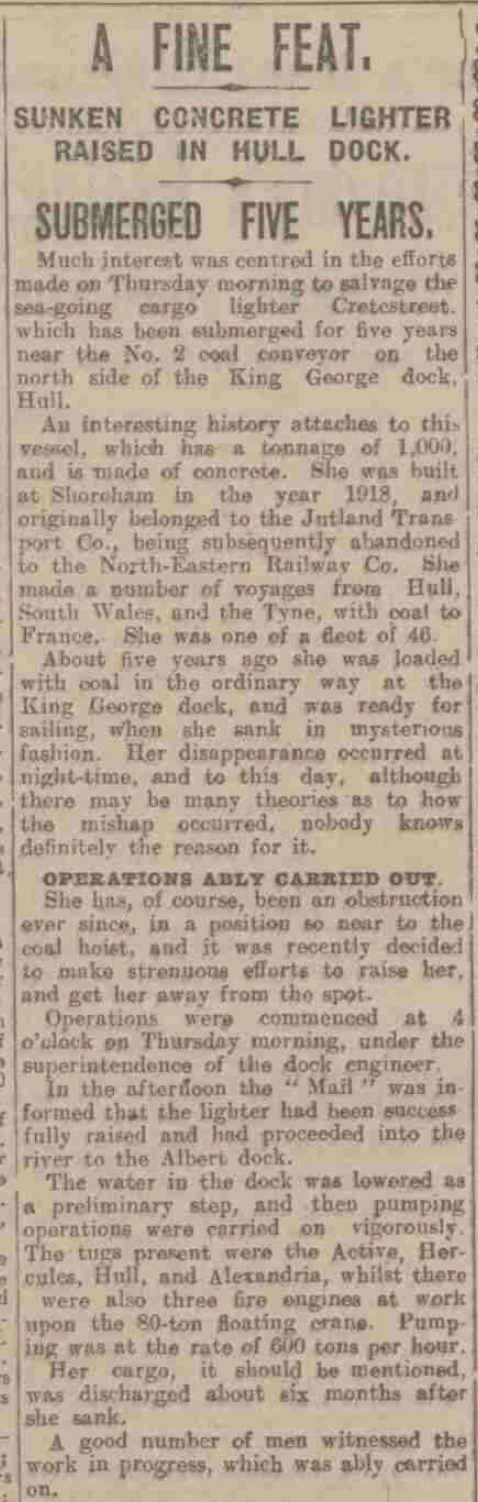
‘Cretestreet’ lay in 35’ of water for almost five years until, as the Hull Daily Mail reported on 23rd January 1925 under the headline ‘A Fine Feat’, she was raised:
‘Much interest was centred in the efforts …to salvage the sea-going cargo lighter ‘Cretestreet’ which has been submerged for five years near the No. 2 coal conveyor on the north side of the King George dock, Hull’.
When one pauses to consider why the British Government offloaded ‘The Crete Fleet’ to the Crete Shipping Co. Ltd, the catalogue of early groundings and inexplicable sinkings is perhaps a strong clue.
The Hull Daily Mail report continued:
‘An interesting history attaches to this vessel, which has a tonnage of 1,000, and is made of concrete. She was built Shoreham in the year 1918, and originally belonged to the Jutland Transport Co., being subsequently abandoned to the North-Eastern Railway Co. She made a number of voyages from Hull, South Wales, and the Tyne, with coal to France. She was one of a fleet of 46’.
The only shipping records I found were of her going to Belgium with pitch. I find no confirmation of her being owned by Jutland Transport Co., but it is of course possible that she was sold privately by The Shipping Controller in early 1920. The article continues:
‘About five years ago she was loaded with coal in the ordinary way at the King George dock and was ready for sailing, when she sank in mysterious fashion. Her disappearance occurred at night-time, and to this day, although there may be many theories as to how the mishap occurred, nobody knows definitely the reason for it’.
Explaining the salvaging of ‘Cretestreet’, the article describes ‘Operations Ably Carried Out’. Having been an obstruction for five years, in a position so close to a coal hoist, it was decided to make strenuous efforts to raise her:
‘Operations were commenced at 4 o’clock in the morning under the superintendence of the dock engineer. The water in the dock was lowered as a preliminary step and then pumping operations were carried on vigorously. The tugs present were the ‘Active’, ‘Hercules’, ‘Hull’ and ‘Alexandria’, whilst there were also three fire engines at work upon the 80-ton floating crane. Pumping was at the rate of 600 tons per hour. Her cargo, it should be mentioned was discharged about six months after she sank. A good number of men apparently witnessed the work in progress, which was ably carried on’.
With the permission of the Humber Conservancy Board, in 1925, ‘Cretestreet’ was then sunk again in a dredged hole to create a groyne.
Nearly a quarter of a century later, in October 1949, she was rammed by the tanker power barge, ‘Lingdale H’ in poor visibility. In 1954, red lights and day markers were placed on ‘Cretestreet’ to make her more visible.
Reaching out to Hull based local history sites, I discovered that she was known locally as the ‘Stone Barge’ and that she was a fantastic fishing platform!
In June 1999 she was ‘buried’ to create an extension of the river wall. ‘Cretestreet’ is positioned near Hull Container Terminal, south of Queen Elizabeth Dock.
Google Earth location is 53°44’07″N 0°15’24″W.
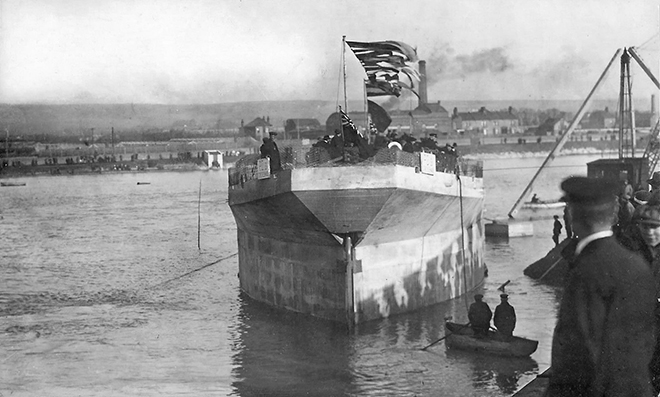
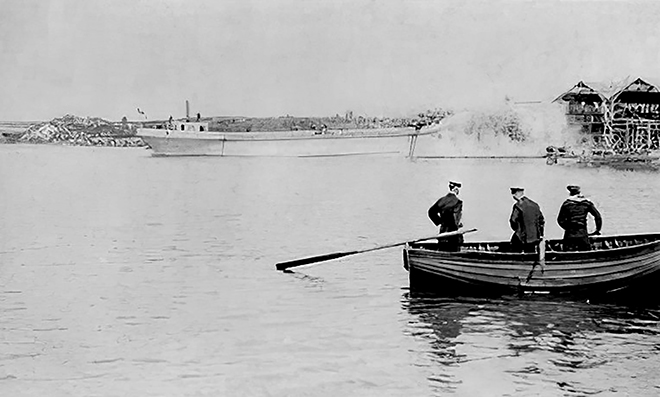
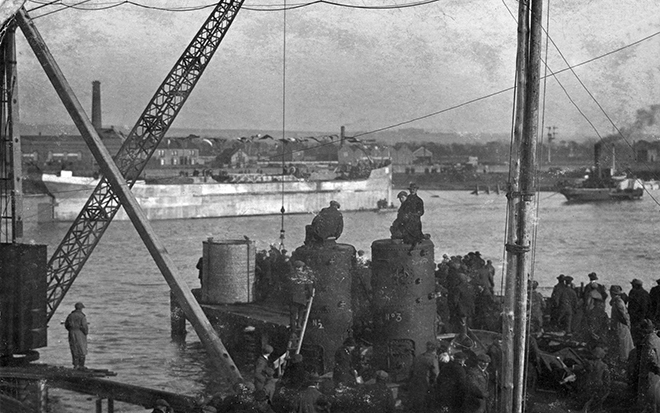
The gallery below contains images of ‘Cretestile’ a sister vessel to ‘Cretestreet’ used with permission of Richard Lewis with all rights reserved.
This article is © Richard G Lewis and is an edited excerpt from two manuscripts, researched and written by the author on the subject of British ferro-concrete ships.
For further information and contact:
Website: www.thecretefleet.com
Facebook: https://www.facebook.com/thecretefleet/
Instagram: https://www.instagram.com/the_crete_fleet/
Thanks very much to Richard for this fascinating article and to Bernard Sharp for his image of ‘Cretestreet’ used with permission and under licence (creativecommons.org/licenses/by-sa/2.0).
Rich and Lou Duffy-Howard